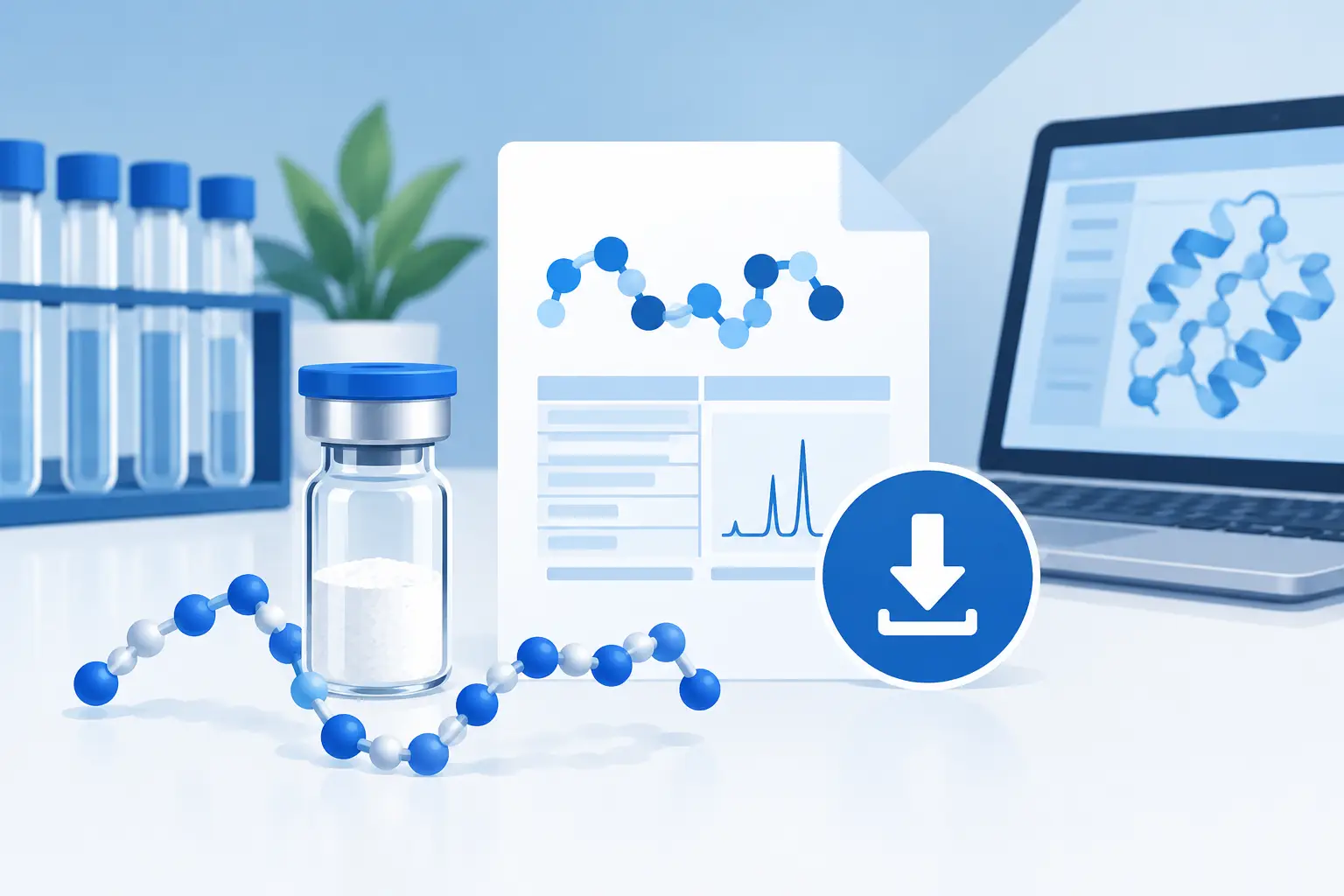




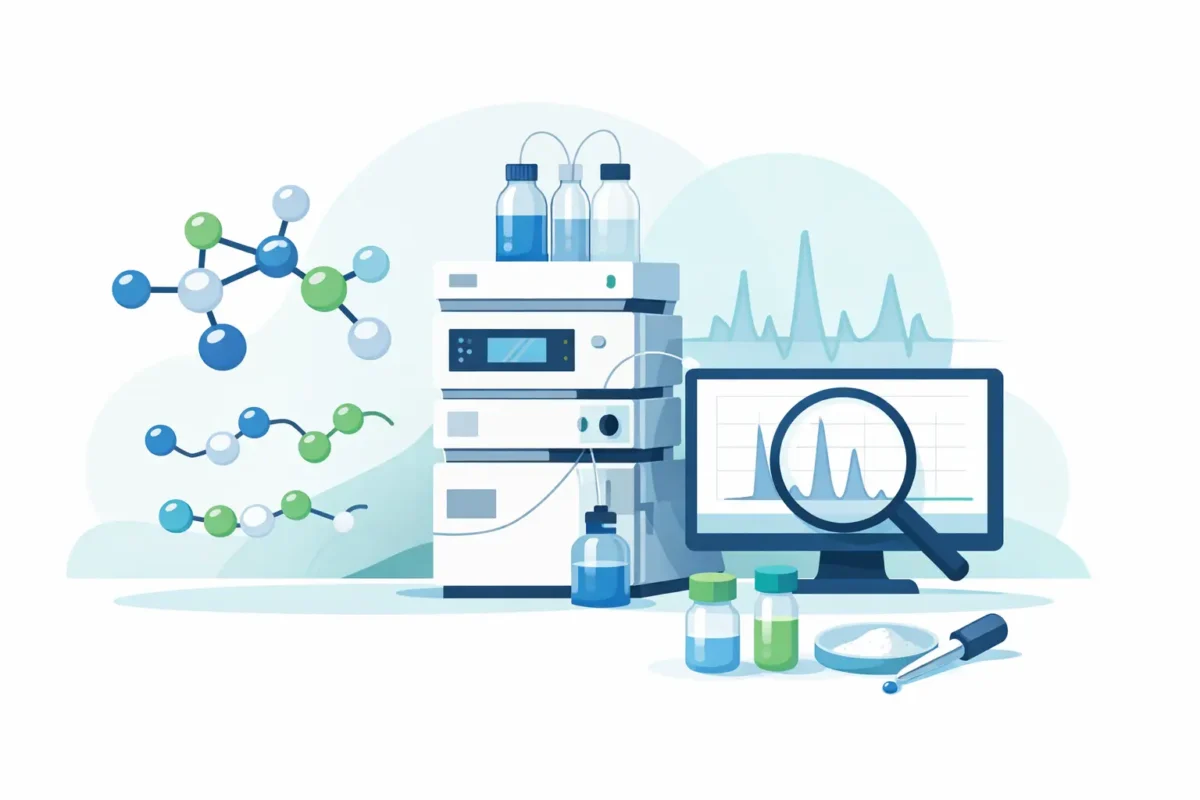
A peptide listed at 99% purity can still be misunderstood if the underlying test data is read too casually. For laboratory buyers, peptide HPLC testing explained in practical terms matters because procurement decisions often depend on one number on a certificate of analysis, while the actual analytical picture is more specific and more limited.
High-performance liquid chromatography, or HPLC, is one of the core analytical tools used to evaluate peptide purity. In peptide sourcing, it is commonly used to separate the main target compound from related impurities, synthesis byproducts, deletion sequences, and residual contaminants that differ enough in chemical behavior to appear as distinct peaks. When a supplier states a peptide is 99% pure by HPLC, that statement usually means the dominant chromatographic peak represents about 99% of the detected peak area under the test conditions used.
That distinction matters. HPLC purity is not the same as absolute identity, and it is not a universal guarantee of suitability for every research application. It is one analytical result generated under a specific method, with a specific column, solvent system, gradient, wavelength, and integration approach. For informed buyers, the value is not just the purity percentage. The value is whether the supplier can document how that figure was produced and whether it aligns with the rest of the batch record.
What peptide HPLC testing actually measures
At its core, HPLC separates components in a sample as they move through a chromatographic column. Peptides interact differently with the stationary phase and mobile phase based on polarity, hydrophobicity, charge behavior, and sequence-specific chemistry. As the sample elutes, the detector records peaks over time. The primary peak is typically assigned to the target peptide, while smaller peaks may indicate impurities or closely related compounds.
For most research-grade peptides, reversed-phase HPLC is the standard approach. This method is particularly useful because many synthetic peptides separate well under reversed-phase conditions, allowing analysts to estimate the relative abundance of the desired sequence compared with other detectable components in the sample.
The reported purity value is generally based on peak area percentage. If the main peak accounts for 99.2% of the total integrated area, the batch may be reported as 99%+ pure by HPLC. That is a meaningful quality marker, but it is still a relative measurement. It reflects what the detector sees under that method, not every possible impurity present in every possible form.
Why HPLC purity is useful, but not sufficient on its own
Research buyers often look for a clean chromatogram because it is one of the clearest indicators of synthesis quality and batch consistency. A strong main peak with minimal secondary peaks usually suggests the manufacturing and purification process was controlled effectively. For procurement, this reduces uncertainty.
Still, HPLC has analytical boundaries. Some impurities may co-elute with the main peak and remain unresolved under a given method. Some non-chromophoric contaminants may not be detected effectively at the selected wavelength. Counterions, residual solvents, moisture content, and certain inorganic residues are not fully characterized by standard peptide HPLC purity testing alone.
This is why serious peptide quality programs do not rely on HPLC in isolation. A credible batch release framework pairs chromatographic purity data with mass spectrometry, and sometimes with additional testing depending on the compound and intended research handling requirements. HPLC helps answer how clean the sample appears chromatographically. Mass spectrometry helps confirm whether the molecular mass matches the expected peptide.
When both results align, buyer confidence increases significantly.
Peptide HPLC testing explained through a COA
For most qualified buyers, the certificate of analysis is where HPLC data becomes actionable. A COA should do more than display a purity claim in large type. It should support that claim with traceable batch information and enough analytical detail to show the testing was real, relevant, and batch-specific.
The first item to verify is batch identification. The COA should match the exact lot or batch tied to the vial being purchased. Generic certificates or recycled documents are weak signals in a category where batch-to-batch variation matters.
Next, look at the purity result itself and how it is stated. If the document says 99% by HPLC, that is useful. If it also includes a chromatogram, retention time, method conditions, or testing date, the document becomes more credible. Not every buyer needs full method validation data for routine procurement, but the presence of real analytical context matters.
Mass spectrometry should also appear on the same COA or associated batch record. HPLC may suggest a clean dominant component, but MS supports identity confirmation by showing the expected molecular weight profile. A supplier offering third-party HPLC and mass spectrometry for each batch, along with downloadable COAs, is giving buyers a stronger basis for evaluation than a supplier making purity claims without documentation.
How to read chromatogram quality without overinterpreting it
A chromatogram can appear clean and still require caution. The main questions are straightforward. Is there a dominant primary peak? Are secondary peaks minor or significant? Does the baseline appear stable? Does the peak shape look reasonable, or is there tailing, fronting, or unresolved overlap that could complicate interpretation?
For routine research procurement, you are not trying to perform a full analytical review equal to method development work. You are looking for signs of control and transparency. A chromatogram with one clearly dominant peak and limited secondary signal is generally favorable. A chromatogram with multiple substantial peaks, poor baseline separation, or unclear labeling deserves more scrutiny.
Retention time alone should not be treated as identity proof. It can support identification, but only within the context of a known method and reference standard. This is where buyers sometimes overread HPLC documents. A retention time match is helpful. It is not a substitute for mass confirmation.
Why third-party testing changes the risk profile
Internal testing has value, especially for process control. But for buyers evaluating supplier credibility, third-party testing reduces a predictable conflict of interest. Independent analytical verification does not make every batch perfect, yet it materially improves trust when the supplier is transparent about the results.
This is especially relevant in peptide ecommerce, where some vendors advertise aggressive purity figures without releasing actual batch documentation. A documented third-party HPLC result, paired with third-party MS and batch-specific COAs, creates a more defensible procurement standard. It also supports reproducibility across repeated orders, which matters more than a one-time headline purity claim.
Synvia Peptides positions this correctly by emphasizing 99%+ purity targets, third-party HPLC and mass spectrometry testing, and downloadable certificates of analysis for every batch. For qualified research buyers, that model addresses the real sourcing concern, which is not just getting a peptide quickly, but getting a peptide with verifiable analytical support.
What HPLC purity does not tell you about a peptide batch
Even strong HPLC data leaves some practical questions unanswered. It does not directly tell you how the material was stored before shipment, whether cold-chain handling was appropriate when required, or whether the powder has absorbed moisture during packaging and transit. It also does not confirm sterility, endotoxin status, or suitability for any use outside the supplier’s stated research-only framework.
This is where disciplined purchasing matters. Buyers should evaluate documentation, fulfillment controls, packaging standards, storage guidance, and legal use restrictions together. A clean HPLC result is a critical signal, but it is one part of a broader quality system.
It also depends on the peptide itself. Some sequences are more analytically straightforward than others. Longer peptides, blends, modified analogues, and highly similar related sequences may require more careful interpretation. In those cases, buyers should be especially cautious about treating a simple purity percentage as the whole story.
What experienced buyers should expect from a peptide supplier
Experienced laboratory buyers usually look for consistency before they look for marketing. They expect batch-specific COAs, not sample documents. They expect analytical methods to be tied to real inventory. They expect purity claims to be paired with identity testing. They also expect the supplier to communicate in compliance terms, especially where research-use-only restrictions and purchaser qualifications are concerned.
A disciplined supplier does not blur analytical language with consumer-style promises. It states what was tested, how the batch performed, and what the material is intended for. That clarity helps buyers protect their workflows and procurement standards.
When peptide HPLC testing is explained correctly, it becomes less of a sales phrase and more of a screening tool. It helps buyers distinguish between documented quality and unverified claims. In a market where small differences in vendor transparency can create major differences in research confidence, that distinction is worth paying attention to every time a new batch is ordered.