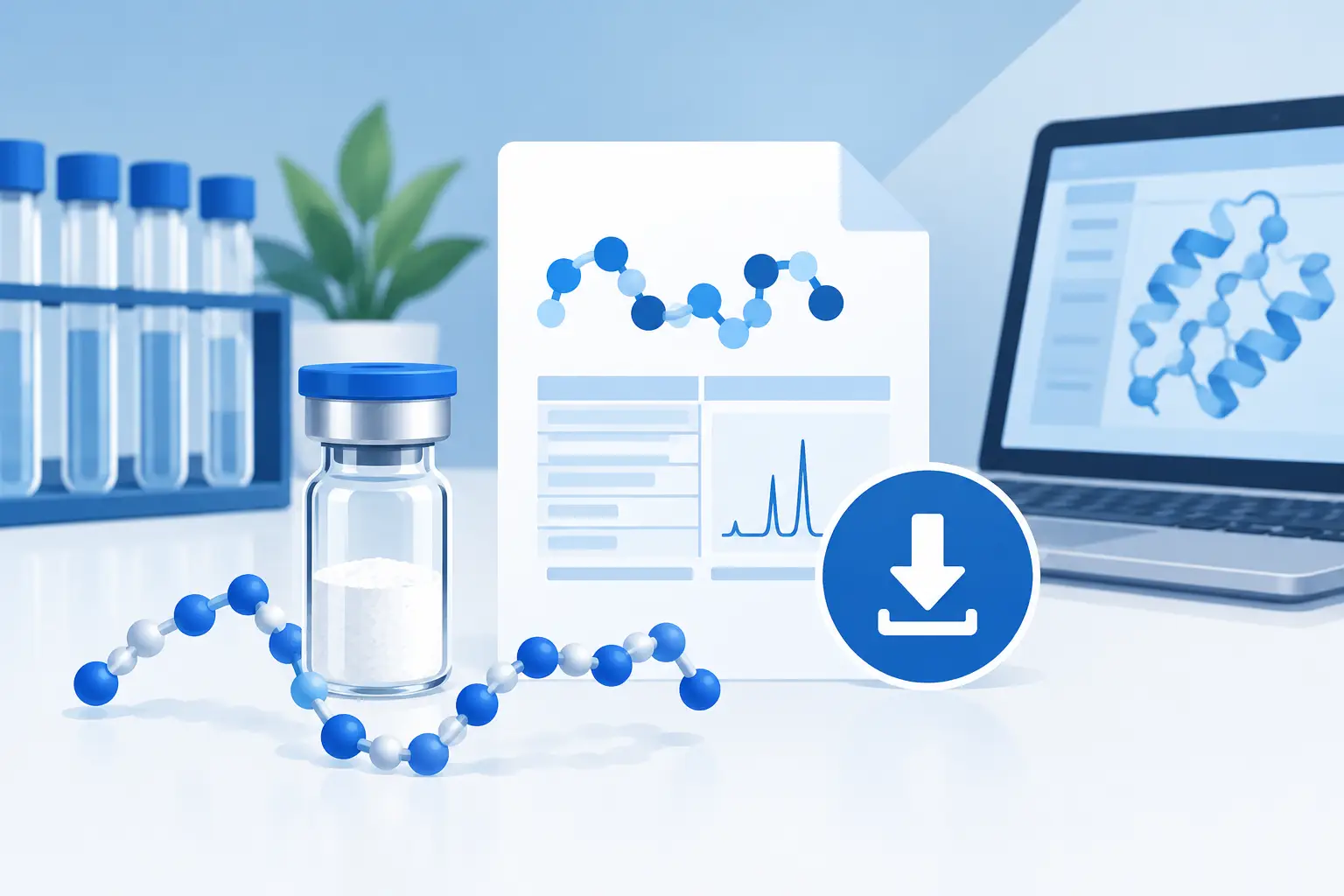


A peptide can meet a high purity specification at release and still become unsuitable for a study if its format, storage history, or handling conditions are poorly controlled. When evaluating lyophilized peptides vs liquid peptides, laboratories should look beyond convenience and assess the format against analytical verification, intended workflow, stability requirements, and traceability.
For research buyers, the decision is rarely about which format is universally better. It is about which format introduces the fewest uncontrolled variables into a specific experimental process. Lyophilized material generally provides stronger long-term storage flexibility, while a liquid preparation can reduce preparation time when its formulation and stability data support the intended use.
What Separates Lyophilized and Liquid Peptides
Lyophilized peptides are peptides that have undergone freeze-drying. The process removes water from a frozen peptide solution under vacuum, leaving a dry solid or cake in the vial. Properly executed lyophilization is intended to reduce hydrolytic degradation and improve stability during storage and shipping.
Liquid peptides are supplied as peptides already dissolved in a solvent or buffer system. Depending on the product, the solution may contain water, buffered aqueous media, organic co-solvents, stabilizers, or other excipients selected for solubility and short-term stability. A liquid format arrives ready for laboratory handling, but the peptide is continuously exposed to its formulation environment from the point of manufacture onward.
The distinction matters because peptides are not chemically uniform as a category. Sequence length, amino-acid composition, terminal modifications, oxidation sensitivity, hygroscopicity, aggregation tendency, and solubility can all affect how a compound performs in either format. A format decision should therefore be compound-specific rather than based on a general assumption about peptides.
Lyophilized Peptides vs Liquid Peptides for Stability
For many research compounds, lyophilized presentation offers the clearest stability advantage before reconstitution. Removing bulk water limits one major pathway for degradation: hydrolysis. Dry material may also be less vulnerable to certain physical changes that can occur in solution, including aggregation or adsorption to container surfaces.
That advantage is conditional. A lyophilized vial is not automatically stable indefinitely, and it is not unaffected by moisture, oxygen, heat, or repeated exposure to ambient air. Poorly sealed vials, compromised stoppers, and unnecessary handling can introduce moisture and reduce the practical benefit of the dry format.
Liquid peptides can be appropriate where a validated solution formulation supports the intended storage period and research use. They may be particularly useful in workflows requiring rapid aliquoting or repeated, time-sensitive preparation. However, the laboratory should understand the solvent system, storage temperature, light sensitivity, and any documented limits on use after opening.
A critical distinction is between manufacturer-controlled stability and end-user assumptions. A product labeled as a liquid preparation should have a defined formulation and handling expectation. If the formulation is unclear, the buyer cannot reasonably evaluate risks related to precipitation, pH drift, oxidation, microbial contamination, or peptide loss to the container.
Storage and Shipping Considerations
Lyophilized material is often preferred for inventory that may be stored before a study begins. It is generally easier to ship and retain as dry material, provided temperature control and moisture protection are maintained. For research programs managing multiple compounds, this can simplify receipt, quarantine, inventory tracking, and staged project planning.
Once reconstituted, a lyophilized peptide becomes subject to many of the same concerns as a peptide supplied in liquid form. The dry state is not a permanent protective condition after solvent is introduced. At that point, solution composition, concentration, storage temperature, light exposure, and freeze-thaw history become central variables.
Liquid preparations require closer attention during shipping because elevated temperatures and transit delays may affect stability. Buyers should also assess whether the solution is shipped in a volume and concentration appropriate for the planned work. A large liquid vial may be convenient initially but can create avoidable exposure from repeated access if the study requires only small working quantities.
For either format, the receiving process should include confirmation of vial integrity, label reconciliation, lot identification, storage transfer, and documentation review. These basic controls are especially relevant when compounds are incorporated into repeatable in-vitro methods or comparative research protocols.
Reconstitution Introduces a Controlled Variable
The main trade-off with lyophilized peptides is reconstitution. The laboratory must select an appropriate solvent, calculate concentration accurately, and mix the material under conditions that preserve the compound’s integrity. That work requires care, but it also gives the researcher control over the final concentration and solution conditions.
A reconstitution plan should be based on the peptide’s documented solubility characteristics and the needs of the assay. Solvent compatibility can vary substantially among compounds. A poorly selected vehicle may cause incomplete dissolution, visible particulates, aggregation, pH instability, or reduced assay reliability.
Liquid peptides remove the initial reconstitution step, but they do not remove the need for controlled handling. A ready-made solution may still require dilution, aliquoting, mixing, and storage procedures. The convenience benefit is real only when the supplied concentration, solvent, and volume fit the protocol without creating additional adjustment steps.
Researchers should avoid treating visual clarity as proof of chemical integrity. A solution can appear clear while containing degradation products or concentration changes that are not visible without analytical assessment. Likewise, a uniform lyophilized cake does not independently confirm identity or purity.
Analytical Documentation Matters More Than Format Alone
Format is one component of quality. Identity, purity, and lot-level documentation remain the more fundamental purchasing criteria. A vial of lyophilized powder with no credible analytical support is not made reliable merely because it is dry. The same is true for a liquid preparation presented as convenient but lacking clear verification.
For research-grade procurement, buyers should look for lot-specific certificates of analysis that identify the material, report purity, and document the analytical methods used. High-performance liquid chromatography and mass spectrometry address different but complementary questions: chromatographic purity and expected molecular mass. Together, they provide a stronger basis for evaluating a supplied research compound.
The certificate should correspond to the specific batch received, not a generic example certificate. It should also be interpreted correctly. A reported purity result describes the tested material at the time of analysis; it does not replace proper storage or establish stability after a vial has been opened, reconstituted, or held under laboratory-specific conditions.
At Synvia Peptides, third-party HPLC and mass spectrometry documentation, downloadable batch-specific COAs, and 99%+ purity standards are central to the research-grade sourcing process. These controls help buyers establish a documented starting point before format-specific handling begins.
Choosing the Appropriate Format for the Workflow
Lyophilized peptides are often the stronger choice when a laboratory needs extended inventory flexibility, plans to prepare custom concentrations, or requires tighter control over the reconstitution vehicle. They can also be practical when several related studies will be conducted over time and aliquots can be prepared according to an approved internal procedure.
Liquid peptides may be preferable when the experimental workflow demands immediate preparation, the supplied formulation has a defined stability profile, and the full vial can be used within the validated handling window. They may reduce preparation variability in settings where a standardized, ready-to-dilute solution is more useful than a dry material requiring solvent selection.
Neither choice eliminates the need for procedural discipline. For a liquid product, the key questions are formulation transparency, stability expectations, container compatibility, and post-opening controls. For a lyophilized product, the priority is moisture-protected storage, suitable reconstitution conditions, accurate concentration calculations, and appropriate aliquoting after dissolution.
Common Procurement Errors to Avoid
The most common error is choosing based only on the label format rather than the full research requirement. A buyer may select liquid material to save time, then discover the concentration is unsuitable for the assay. Another may select lyophilized material for storage flexibility without confirming that an appropriate reconstitution method is available.
A second error is overlooking batch documentation. Research reproducibility depends on knowing what entered the workflow. Lot numbers, purity data, mass confirmation, receipt dates, storage conditions, and preparation records should remain connected to the experimental record.
A third error is treating peptides as interchangeable. Compounds used in hormone and growth-axis research, immune signaling studies, mitochondrial and cellular health investigations, metabolic research, CNS studies, tissue-repair models, or pigmentation research may have different handling requirements. The peptide sequence and formulation should guide the procedure.
All peptide materials should be purchased, handled, and used solely for lawful in-vitro research by qualified purchasers. They are not approved for human or veterinary use, and product format does not alter that restriction.
A well-controlled peptide workflow begins before the vial is opened. Select the format that matches the study timeline and handling capacity, verify the batch data, document the storage chain, and ensure the preparation method is defined before the material reaches the bench.