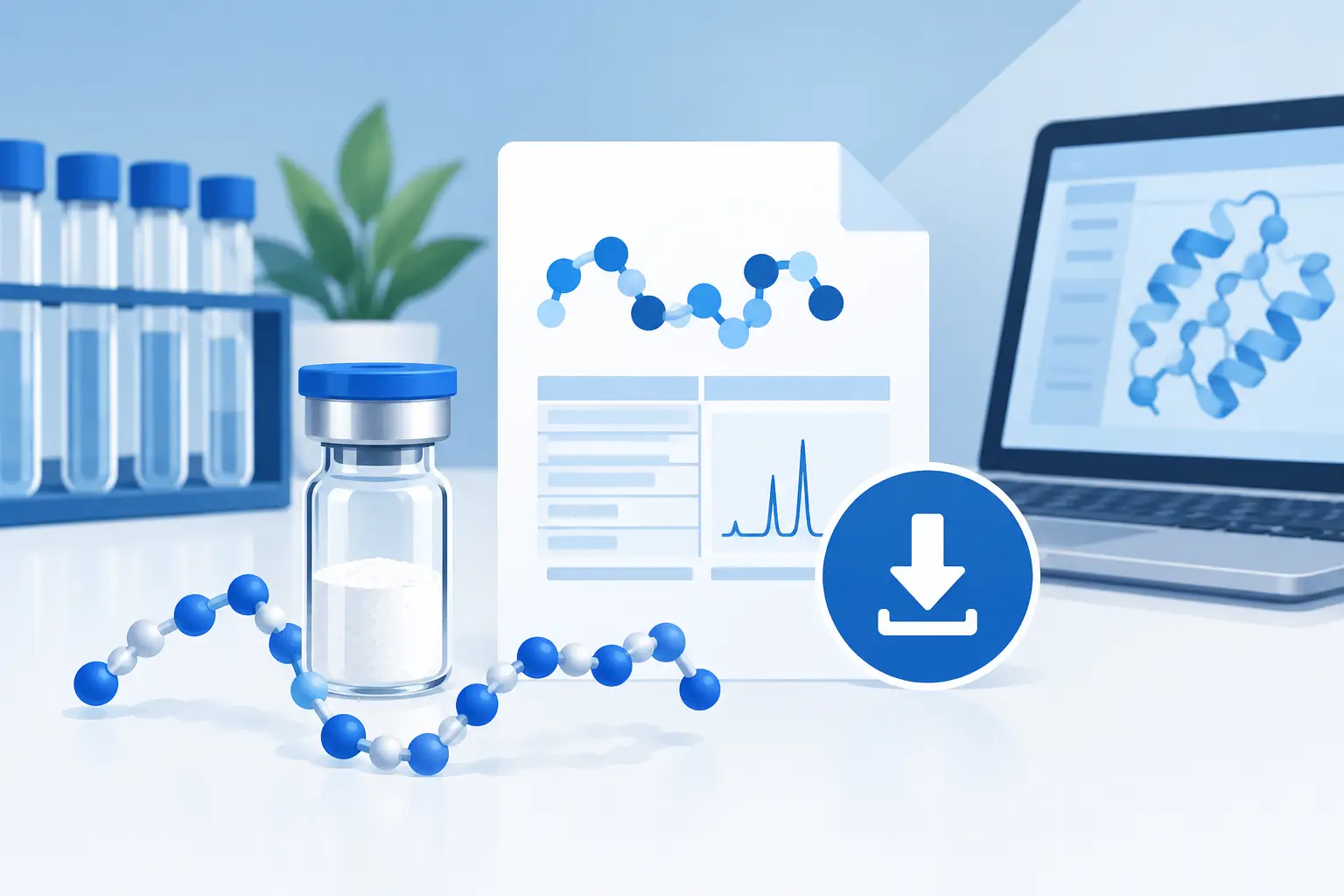




A peptide may be labeled at 99% purity, but that number has limited procurement value without the documentation behind it. For laboratories evaluating a research-use-only material, the question is not simply whether a supplier provides paperwork. It is what peptide testing documents matter, whether they are tied to the exact batch being purchased, and whether the underlying data supports identity, purity, and traceability.
A credible documentation package should allow a qualified buyer to connect a labeled vial to a defined lot, a stated analytical result, and a controlled release decision. It should also make clear what the test does and does not establish. A high-purity HPLC result, for example, does not independently confirm molecular identity or sterility.
What Peptide Testing Documents Matter for Procurement?
For routine research procurement, the core documents are a batch-specific certificate of analysis, HPLC purity data, and mass spectrometry identity data. Depending on the compound, intended workflow, and institutional requirements, buyers may also need manufacturing date information, retest or expiration details, residual solvent data, water content, microbiological testing, endotoxin results, or shipping and storage records.
The proper depth of review depends on research risk. An early-stage in-vitro screen may require a different documentation threshold than a study where trace contaminants, salt form, aggregation, or concentration accuracy could distort results. The standard should be fit for purpose, but it should never be based solely on a generic purity claim.
The batch-specific certificate of analysis
The certificate of analysis, or COA, is the primary release document for a peptide batch. It should identify the material clearly by compound name, batch or lot number, and relevant specifications. The lot number on the COA should match the lot number supplied with the product. If there is no traceable lot identifier, the buyer cannot verify that the document applies to the material received.
A useful COA generally includes the stated purity result, identity test result, analytical methods used, molecular weight or expected mass information, date of analysis or release, and an authorized quality-control review. It should also state the material form where relevant, such as acetate, trifluoroacetate, or another counterion form.
A COA is not a substitute for the raw analytical record. It is a controlled summary of results. For many qualified buyers, that summary is sufficient for initial procurement. For higher-risk or method-sensitive work, it should be reviewed alongside the chromatogram and mass spectrum.
HPLC Documentation: Purity Requires Context
High-performance liquid chromatography is commonly used to assess peptide purity. The reported percentage typically reflects the relative area of the main chromatographic peak under a stated analytical method. A result of 99% or greater can be a meaningful quality marker, but only when the document identifies the batch and provides enough method context to evaluate the claim.
The strongest HPLC package includes a chromatogram, method conditions, sample identification, and a stated purity calculation. At minimum, the chromatogram should show the principal peak and any detectable secondary peaks. Retention time alone does not confirm identity, but it helps establish consistency when reviewed with the method and mass spectrometry result.
Researchers should also ask what the purity percentage represents. Area-percent HPLC is useful for identifying chromatographically resolved impurities, yet it may not capture every issue that affects experimental performance. Non-UV-active contaminants, residual solvents, water, counterions, and co-eluting materials may require separate methods. This is why a single purity number should not be treated as a complete quality profile.
Method comparability matters for repeat purchasing. A supplier may report similar purity values across lots while using different columns, gradients, wavelengths, or integration settings. That does not automatically indicate a problem, but meaningful batch-to-batch comparison requires controlled methods and clearly documented specifications.
What to look for in an HPLC chromatogram
A chromatogram should be legible enough to assess the separation and signal profile. Look for the sample or lot identifier, detector wavelength, retention time, axis labels, and a result that corresponds to the COA. A broad, split, or poorly resolved main peak may warrant questions, especially where the material is expected to be homogeneous.
The practical question is not whether a chromatogram looks visually clean at a glance. It is whether the method used is appropriate for the peptide and whether the reported result is linked to the exact material under review.
Mass Spectrometry Documentation: Confirming Identity
Mass spectrometry, commonly listed as MS or LC-MS, supports confirmation that the peptide has the expected molecular mass. For research peptide procurement, this is a critical second line of verification because HPLC purity alone cannot establish that the principal peak is the intended sequence.
A meaningful MS record should identify the expected molecular weight and observed mass or mass-to-charge values. Peptides often appear in multiple charge states, so the spectrum may show several peaks corresponding to the same analyte. That is normal. The key is that the interpreted result supports the expected molecular mass within an appropriate tolerance.
Mass spectrometry confirms molecular mass, not full sequence verification in every case. Different structures can occasionally have similar or identical nominal masses, and MS does not necessarily identify positional isomers, epimerization, or every sequence-related impurity. More advanced identity work may require peptide mapping, tandem mass spectrometry, amino acid analysis, or other orthogonal methods. Whether those are necessary depends on the project and the consequences of an incorrect assignment.
For standard catalog peptides, a batch-linked MS identity result combined with HPLC purity data provides a practical and credible starting point. For custom synthesis, novel sequences, or sensitive assay development, a buyer may reasonably require expanded identity characterization.
Supporting Documents That May Matter
The COA, HPLC record, and MS result form the core package, but they do not answer every laboratory question. Additional documents become relevant based on the peptide, the experimental method, and the receiving institution’s quality system.
Residual solvent testing may be relevant when trace organic solvents could affect a cell-based assay or interfere with analytical work. Karl Fischer water determination can be useful for hygroscopic materials and accurate mass-based preparation. Counterion content may matter when preparing solutions by weight, since the listed peptide mass can include associated salts or water.
For work where biological contamination would compromise the study, ask whether the supplier provides bioburden, endotoxin, or microbial limits testing. These results should not be assumed from a high HPLC purity result. Analytical purity, sterility, and endotoxin control are separate attributes measured by separate methods.
Storage and stability information also deserves review. A document should state recommended storage conditions and, where available, retest dating or stability support. A date on a COA does not prove indefinite stability. Peptides can be affected by temperature excursions, moisture exposure, repeated handling, and reconstitution conditions.
Traceability and Document Control Are Quality Signals
Even technically sound data loses value when document control is weak. A professional testing package uses consistent identifiers across the product label, COA, chromatogram, and mass spectrum. It has clear issue dates, controlled formatting, and no unexplained discrepancies in compound name, molecular weight, or lot number.
Buyers should be cautious with generic COAs that do not identify a specific batch, copied chromatograms used across multiple products, or certificates that omit the laboratory or testing method. These gaps do not prove a material is deficient, but they prevent a research buyer from performing a defensible review.
Third-party testing can add confidence by creating analytical separation between the supplier and the testing laboratory. However, third-party status alone is not enough. The report still needs to be batch-specific, interpretable, and relevant to the claim being made. A third-party report with no lot number is less useful than a controlled, traceable in-house record.
Synvia Peptides maintains batch-level documentation as a core procurement control, including third-party HPLC and mass spectrometry verification for applicable research materials. Qualified buyers should retain downloaded records with receiving documentation, particularly when materials are used across multiple experiments or reordered over time.
A Practical Review Before You Place an Order
Before adding a peptide to a research workflow, verify that the supplier can provide a batch-specific COA and that the lot number can be matched on receipt. Confirm that HPLC purity and MS identity results are included or available for review. Then determine whether your method requires additional evidence, such as endotoxin, residual solvent, water content, counterion information, or stability support.
Do not confuse documentation with authorization for any particular use. Research-grade peptide records support sourcing, traceability, and material assessment for legitimate laboratory research. They do not establish safety, efficacy, dosage, clinical suitability, or approval for human or veterinary administration.
The right document package is the one that lets your laboratory make a clear, proportionate decision before the material reaches the bench. When every result maps to the same batch and every claim has a defined analytical basis, procurement becomes easier to defend and experimental variability becomes easier to investigate.