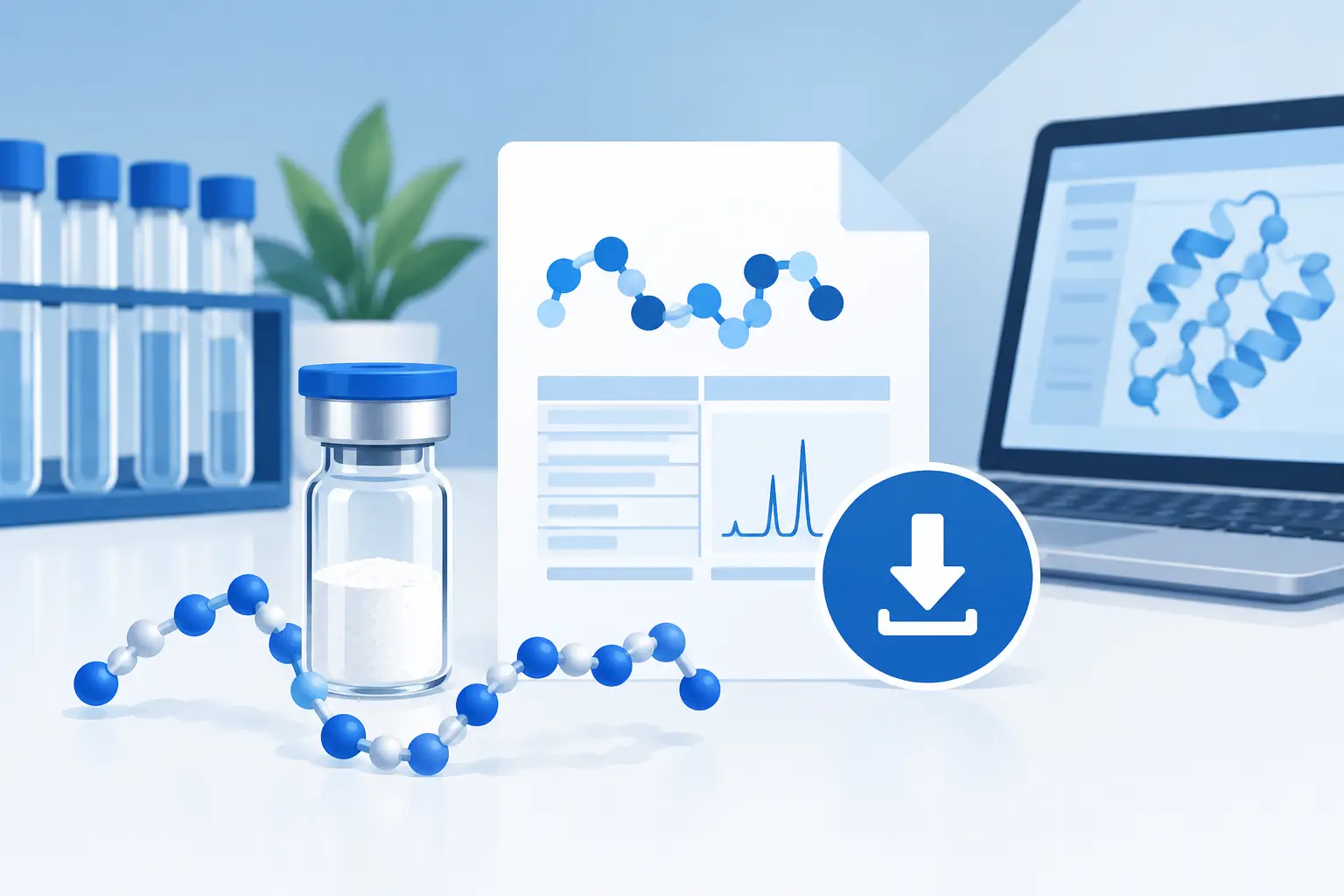




A vial is a container. Lyophilized powder is a peptide presentation. Treating them as competing formats creates avoidable confusion during procurement, receipt, and method planning. In practice, the peptide vials versus lyophilized powder question is usually a question about what is inside the vial, how it was prepared for shipment, and whether its documentation supports the intended in-vitro workflow.
For qualified research buyers, the practical priority is not choosing one term over the other. It is confirming the material identity, net content, purity, batch-specific analytical data, storage requirements, and research-use-only status before the material enters a study.
Peptide Vials Versus Lyophilized Powder: The Core Difference
A peptide vial is the primary packaging system used to contain a peptide. Depending on the product, that vial may hold lyophilized powder, a pre-dissolved solution, or another prepared format. The vial itself does not establish the peptide’s stability, purity, concentration, or suitability for a particular assay.
Lyophilized powder is peptide material that has undergone freeze-drying. During lyophilization, water is removed under controlled conditions after freezing, leaving a dry solid designed to reduce the risks associated with prolonged exposure to water. For many research peptides, this presentation supports storage, transport, inventory control, and later preparation for a validated experimental method.
The more accurate comparison is therefore between a lyophilized peptide supplied in a vial and a peptide supplied as a solution in a vial. Both may arrive in identical-looking containers. Their handling requirements and stability considerations can be materially different.
Why Lyophilized Peptides Are Common in Research Supply
Peptides are chains of amino acids, and their integrity can be affected by moisture, temperature, oxidation, light exposure, pH, repeated handling, and time in solution. The degree of sensitivity varies by sequence, modification, salt form, molecular weight, and formulation. There is no universal storage rule that applies equally to every compound.
Lyophilization is widely used because a dry peptide is often more manageable for distribution and longer-term storage than the same peptide maintained in an aqueous solution. Removing water can slow degradation pathways associated with hydrolysis and microbial contamination. It does not make a peptide indestructible, nor does it eliminate the need for controlled storage.
A properly supplied lyophilized material should be evaluated as a complete system: the stated peptide identity, amount per vial, batch number, analytical results, recommended storage conditions, closure integrity, and packaging controls. A white or off-white cake alone is not proof of quality. Appearance can support a receipt inspection, but it cannot replace chromatographic and mass-based verification.
Lyophilized Form Does Not Mean Ready-to-Use
Dry peptide must be prepared according to the requirements of the specific research method before use. The appropriate solvent system, target concentration, mixing approach, aliquoting plan, and stability window depend on the compound and the assay. These variables should be defined in the laboratory protocol rather than assumed from a generic product description.
This distinction matters for reproducibility. A lab may source a high-purity lyophilized peptide but still introduce variability through unvalidated solution preparation, incompatible matrices, repeated freeze-thaw exposure, or poor sample labeling. Source quality and workflow discipline are connected, but they are not interchangeable.
When a Solution Format May Be Appropriate
A solution-format peptide can reduce preparation time when a laboratory requires a known concentration for immediate, controlled use. It may also be appropriate for workflows where the vendor has established a specific solvent system, concentration, and stability profile. However, convenience should be weighed against the additional risks associated with shipping and storing a peptide in solution.
A solution introduces more variables for the buyer to review. These include the identity and grade of the solvent, concentration accuracy, container compatibility, solution pH where applicable, storage temperature, expiration dating, and the validated period of use after opening. Research teams should also assess whether the supplied concentration aligns with their assay design or creates unnecessary dilution steps.
For many buyers, lyophilized material offers greater flexibility because it allows the laboratory to prepare the peptide within its own documented method. For others, a validated solution may better fit high-throughput or time-sensitive workflows. The correct choice depends on the protocol, not on a blanket preference for dry or liquid material.
What to Verify Before Purchasing Peptide Vials
Whether a vial contains lyophilized powder or a prepared solution, procurement should begin with batch-level evidence. A credible supplier provides documentation that allows a research buyer to evaluate identity and quality rather than relying on marketing language alone.
At minimum, review the certificate of analysis for the applicable batch. The document should identify the compound, lot or batch number, reported purity, test methods, and analytical findings. High-performance liquid chromatography is commonly used to evaluate purity profiles, while mass spectrometry helps confirm molecular identity. A stated purity threshold has value only when it is tied to identifiable testing and the batch being purchased.
Net peptide content also requires close attention. A label stating a mass per vial is not the same as a concentration claim. With lyophilized material, the purchaser should understand whether the declared amount refers to peptide content, total material, or another defined basis. For solutions, verify both total volume and concentration, then confirm that the stated amount supports the planned number of experiments.
Synvia Peptides emphasizes batch-specific certificates of analysis, third-party HPLC and mass spectrometry testing, and 99%+ purity standards because these are the records that help qualified buyers assess material consistency before research use.
Packaging and Shipping Controls Matter
The vial is more than a shipping vessel. Container material, stopper integrity, crimp quality, labeling, desiccation controls, and secondary packaging can influence the condition of the material at receipt. A reliable supplier should provide clear storage instructions and use packaging appropriate to the product’s stated requirements.
Upon receipt, laboratories should record the lot number, inspect the package for damage, compare the vial label against the order and COA, and move the material into specified storage without unnecessary delay. If the lyophilized cake appears compromised, the seal is damaged, or documentation does not match the received batch, the material should be quarantined pending supplier review.
Selecting the Right Format for the Workflow
The decision can be made more clearly by asking a few operational questions. Does the protocol require the lab to control the solvent and final concentration? Is the study likely to extend over weeks or months? Will the material be used once, or repeatedly across multiple assay runs? Does the laboratory have a validated process for preparing, labeling, and storing peptide solutions?
Lyophilized powder is often a strong fit when flexibility, controlled preparation, and storage planning are central to the workflow. It can allow a lab to prepare only the amount needed for a defined experiment, subject to its internal procedures. This may reduce unnecessary time in solution and support more deliberate inventory management.
A supplied solution may be preferable when the protocol requires immediate use at a defined concentration and the supplier can document the formulation and stability conditions adequately. The trade-off is less control over preparation variables and potentially narrower storage tolerance after receipt or opening.
Neither format compensates for an incomplete research plan. A peptide selected for an in-vitro study should be supported by an established handling SOP, suitable analytical controls, documented sample traceability, and a clear endpoint for evaluating results.
Common Procurement Errors to Avoid
The most frequent error is assuming that all peptide vials contain the same type of material. Product listings should state whether the peptide is lyophilized, supplied in solution, or otherwise formulated. When that information is unclear, the buyer should request clarification before ordering.
Another error is comparing products only by milligram quantity. Two vials with the same stated mass can differ in purity, analytical verification, sequence identity, salt form, storage needs, and supporting documentation. The lower-cost item is not necessarily the lower-cost research input once failed runs, delayed timelines, and repeat procurement are considered.
Finally, do not interpret research-grade labeling as authorization for human or veterinary use. Research peptides are intended solely for qualified laboratory and in-vitro research purposes. Purchasers remain responsible for complying with applicable laws, institutional requirements, and safe laboratory practices.
Build the Decision Around Evidence
The right question is not whether peptide vials are better than lyophilized powder. A vial may contain lyophilized powder, making the two terms complementary rather than opposed. The meaningful decision is whether the peptide presentation, packaging, analytical documentation, and storage profile support the exact research workflow being planned.
When the records are clear and the handling plan is defined before purchase, the vial becomes what it should be: a traceable, controlled starting point for reliable research.