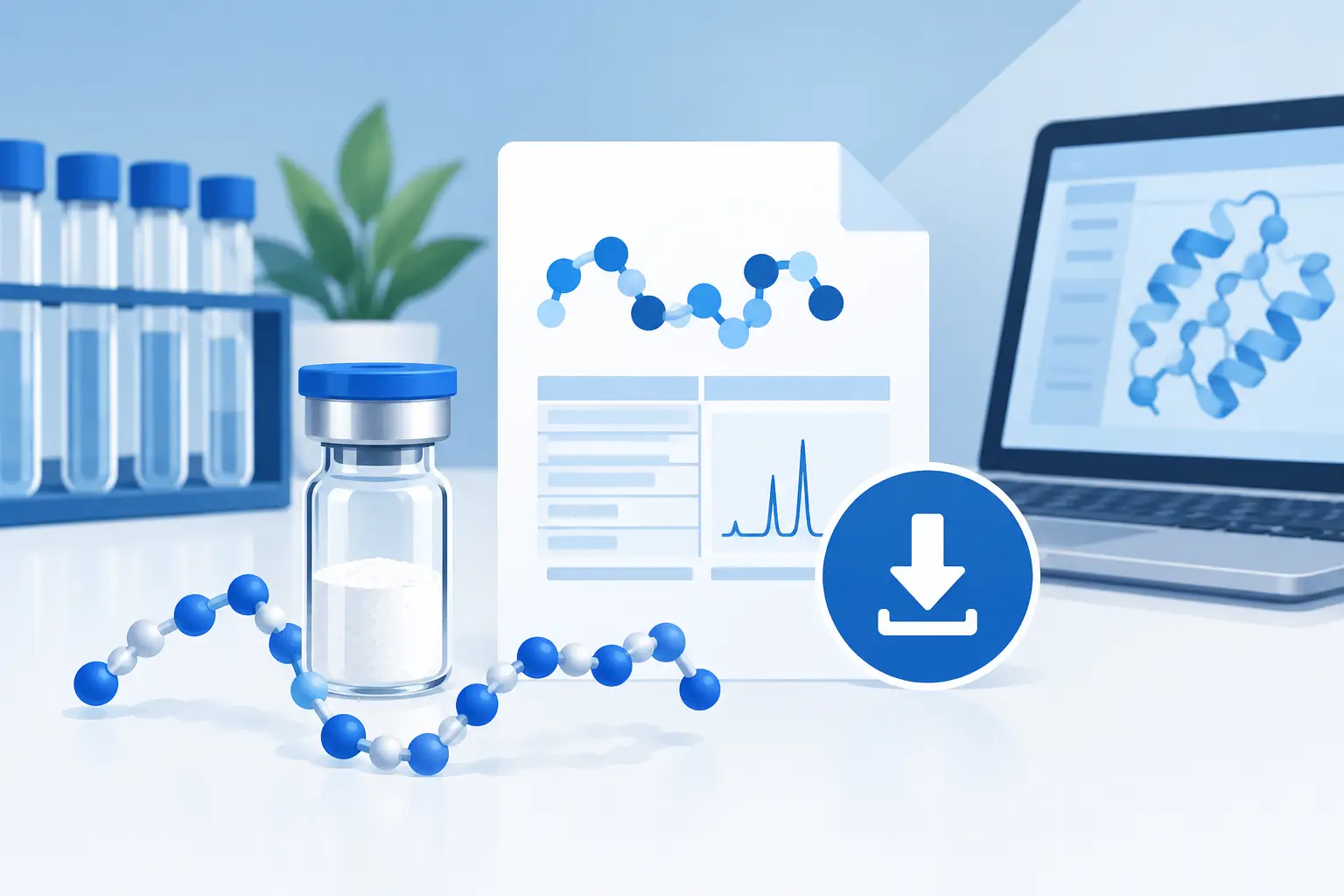




A chromatogram can look clean while still leaving meaningful analytical questions unanswered. So, can HPLC detect impurities in peptide samples? Yes – when the method is appropriately developed, HPLC is one of the primary tools used to identify and quantify chromatographically distinguishable impurities. It is not, however, a universal proof that a material contains only the intended peptide.
For research buyers evaluating peptide quality, that distinction matters. A reported HPLC purity value describes what the method detected under defined conditions. It does not automatically establish molecular identity, rule out co-eluting species, or replace confirmation by mass spectrometry and other fit-for-purpose analytical controls.
Can HPLC Detect Impurities Reliably?
High-performance liquid chromatography separates compounds as they travel through a column under pressure. Components interact differently with the stationary phase and mobile phase, producing peaks at different retention times. In peptide quality control, reversed-phase HPLC is commonly used because it can separate peptides and many peptide-related byproducts based on hydrophobic interactions.
If an impurity produces a distinct, resolved peak, HPLC can detect it. Peak area may then be used to estimate the impurity level relative to the principal peak, typically through area normalization or a validated quantitative method. This is why an HPLC chromatogram is valuable batch documentation: it provides a direct visual record of the separation achieved for that sample.
Reliability depends on method performance, not simply on whether an instrument was used. A useful impurity method must provide adequate resolution between the main peptide and nearby peaks, suitable detection sensitivity, consistent retention behavior, and a signal-to-noise ratio that supports the stated reporting threshold. A chromatogram with a broad main peak, poor baseline separation, or insufficient run time may obscure impurities that a better method would reveal.
For peptide materials, the most relevant impurities often arise during synthesis, cleavage, purification, handling, or storage. These can include deletion sequences, truncated sequences, incompletely deprotected material, oxidized forms, deamidated variants, aggregation-related species, and residual process-related compounds. Whether HPLC detects each one depends on whether it separates from the intended analyte and responds at the detector wavelength.
What an HPLC Purity Result Actually Means
A statement such as 99% HPLC purity generally means that approximately 99% of the integrated chromatographic area was assigned to the main peak under the stated test conditions. It is a meaningful quality indicator, especially when supported by a readable chromatogram and defined test parameters. It should not be interpreted as an absolute statement that 99% of every molecule in the vial is chemically identical to the target sequence.
Several variables shape the result. The column chemistry, gradient profile, solvent composition, flow rate, temperature, injection amount, detection wavelength, and integration settings can all affect peak shape and calculated area percentage. A method optimized for one peptide may not be equally informative for another, particularly when sequences differ in length, charge, hydrophobicity, or susceptibility to modification.
UV detection also has limits. Most peptide HPLC methods use UV absorbance, often near 214 nm or 220 nm, where peptide bonds absorb strongly. This approach is sensitive for peptide-related material, but response factors can vary between compounds. An impurity with a weak or different UV response may be underrepresented when purity is calculated by peak area alone.
The practical interpretation is straightforward: HPLC purity is a method-specific measurement. It is highly useful for comparing batches, monitoring purification performance, and screening for detectable related substances. It gains far more weight when the certificate of analysis identifies the method and is paired with orthogonal identity confirmation.
Where HPLC Can Miss Impurities
The main limitation is co-elution. Two compounds can exit the column at nearly the same time and appear as one peak if the method does not resolve them. In that situation, the chromatogram may show a single symmetrical peak even though more than one chemical species is present.
Peptides make this challenge especially relevant. Closely related sequences may differ by a single amino acid, a deletion, an oxidation event, or an isomeric change. Some of these variants separate well under a given gradient; others require different column selectivity, a modified mobile phase, or a longer method to reveal themselves. One HPLC condition is rarely sufficient to demonstrate separation of every plausible impurity.
HPLC may also be less suitable as a standalone test for nonchromophoric contaminants, volatile residual solvents, inorganic salts, elemental impurities, endotoxin, bioburden, or certain particulate contaminants. These require methods designed for those specific risks. Gas chromatography, inductively coupled plasma mass spectrometry, microbial testing, endotoxin assays, and moisture analysis answer different quality questions than peptide purity HPLC.
Detection thresholds matter as well. Every method has a limit of detection and limit of quantitation. A trace impurity may be present below the level at which the method can reliably report or quantify it. That does not make HPLC ineffective. It means reported purity should always be read alongside the analytical method’s intended use and sensitivity.
Why Mass Spectrometry Complements HPLC
Mass spectrometry provides a different form of evidence. While HPLC primarily separates compounds by retention behavior, mass spectrometry measures ions according to their mass-to-charge ratio. For peptide identity testing, the observed molecular mass can be compared with the expected mass for the target sequence.
This is particularly valuable when an HPLC main peak needs confirmation. A peak at the expected retention time is not, by itself, definitive proof of identity. Mass spectrometry can confirm that the principal component has a mass consistent with the specified peptide. When HPLC is coupled directly to mass spectrometry, analysts can examine the mass profile across individual chromatographic peaks, helping distinguish co-eluting or closely eluting components.
Mass data also has boundaries. Compounds with the same nominal or near-identical mass may still require higher-resolution instrumentation, fragmentation analysis, or additional methods for differentiation. Still, the combination of HPLC and mass spectrometry is materially stronger than either result presented without context.
For qualified research buyers, the most useful documentation typically shows both: an HPLC chromatogram supporting purity assessment and mass spectrometry data supporting identity. These methods answer related but distinct questions. HPLC asks whether the sample contains separable components and in what relative proportion. Mass spectrometry asks whether the observed molecular mass aligns with the intended analyte.
How to Review a Peptide COA for Impurity Control
A certificate of analysis should support a purchasing decision, not merely display a purity percentage. Review the documentation as a batch-specific record. The following details are particularly relevant when assessing whether HPLC impurity testing is meaningful:
- Batch or lot number that matches the product label and supplied material.
- Reported purity result, analytical date, and the chromatogram rather than an unsupported claim.
- HPLC conditions or sufficient method information to understand the separation context.
- Mass spectrometry results showing an observed mass consistent with the target peptide.
- Storage guidance, net content, and research-use status where applicable.
A 99%+ result is most credible when it is traceable to a defined batch and supported by underlying analytical data. Documentation should also be current enough to reflect the material being purchased, rather than a generic image reused across unrelated lots.
Researchers should consider the intended experiment before setting acceptance criteria. Early in-vitro screening may require a different impurity profile and documentation package than a sensitive mechanistic assay, receptor-binding study, or analytical reference application. The correct standard is not simply the highest purity number available. It is a documented, reproducible material specification that fits the study design.
Selecting Materials With Defensible Analytical Support
For peptide sourcing, HPLC should be viewed as a central quality-control tool, not a single-test guarantee. A supplier that provides third-party HPLC and mass spectrometry testing, batch-specific certificates of analysis, and clear research-use-only documentation gives research purchasers a more defensible basis for material selection.
Synvia Peptides provides downloadable batch documentation for research-grade materials and applies analytical verification as part of its quality framework. Buyers should still review each available COA against their own protocol requirements, institutional policies, and acceptance criteria.
The strongest procurement decision comes from asking a precise question: not only whether HPLC detected impurities, but which impurities the method could reasonably detect, at what level, and what independent evidence confirms the material’s identity. That level of review helps keep experimental inputs aligned with the quality of the data researchers expect to produce.