




A peptide can present as 99% pure and still fail to be the peptide listed on the label. That distinction sits at the center of peptide purity versus identity, and it is one of the most consequential quality-control questions in research sourcing. For laboratories working with reference materials, assay development, in-vitro models, or controlled exploratory work, a high purity number alone is not a complete release standard.
Purity and identity answer different questions. Purity evaluates how much of a sample is represented by its main chromatographic component. Identity evaluates whether that component is the intended molecular entity. A defensible sourcing decision requires evidence for both, supported by batch-specific documentation rather than a generic specification sheet.
Peptide Purity Versus Identity: Two Different Claims
Purity is commonly expressed as a percentage, such as 99%+ by HPLC. In practical terms, this result indicates that the principal peak accounts for a stated proportion of the measured chromatographic signal under the method conditions used. It is a useful measure of sample composition and process quality, particularly when reviewing lot-to-lot consistency.
It does not, by itself, establish the sequence, molecular mass, salt form, or intended structure of the principal peak. An incorrect peptide, a truncated sequence, a synthesis-related analog, or a sample handling error may still produce a dominant, apparently clean peak. HPLC can show that one component predominates. It cannot independently prove what that component is.
Identity testing addresses that separate question. For synthetic peptides, mass spectrometry is a standard identity tool because it measures molecular mass and can confirm whether the observed mass aligns with the expected mass for the stated compound. Depending on the analytical method and research requirement, additional characterization may be appropriate, including sequence confirmation, amino acid analysis, or specialized impurity profiling.
The distinction matters because a clean chromatogram is not interchangeable with molecular confirmation. A laboratory that treats purity as proof of identity can introduce an avoidable variable before an experiment begins.
What HPLC Purity Results Can and Cannot Tell You
High-performance liquid chromatography separates components based on their interaction with the column and mobile phase. A typical peptide HPLC report provides a chromatogram, retention times, integrated peak areas, and a reported purity value. It is especially valuable for detecting and quantifying chromatographically resolvable impurities in a batch.
For procurement review, the most useful HPLC documentation is batch-specific and interpretable. The report should identify the lot, state the analytical method or conditions, show the chromatogram rather than only a percentage claim, and provide a result that corresponds to the batch being purchased.
However, purity values have context. A 99% result obtained under one method is not necessarily directly comparable with a 99% result from another laboratory, column chemistry, gradient, wavelength, or integration approach. Some impurities may co-elute with the primary peak. Others may be poorly detected at the selected wavelength. Counterion content, residual solvents, water content, and non-peptidic material may also not be fully represented by a simple area-percent purity figure.
This does not diminish the value of HPLC. It defines its role. HPLC is a critical composition and impurity-assessment tool, but it should be reviewed alongside identity data and, where the study requires it, additional material-characterization information.
Purity is not potency or suitability
A reported 99%+ HPLC purity should not be interpreted as 99% biological activity, 99% assay performance, or automatic suitability for every research protocol. Peptide performance depends on factors beyond chromatographic purity, including correct identity, concentration accuracy, stability, solvent compatibility, storage history, and experimental design.
For sensitive cell-based or receptor-binding studies, even low-level contaminants or degradation products can become relevant. The acceptable standard depends on the intended research use, the compound class, and the risk tolerance of the method.
How Mass Spectrometry Supports Peptide Identity
Mass spectrometry provides an orthogonal line of evidence by measuring ions according to mass-to-charge ratio. For a peptide supplier, a mass spectrometry result should show an observed molecular mass that is consistent with the theoretical mass expected for the stated peptide.
This comparison is valuable because many synthesis errors change molecular mass. Missing residues, added residues, oxidation, incomplete deprotection, and certain modifications can often be identified or flagged through mass data. When paired with HPLC, mass spectrometry helps establish that the dominant chromatographic component is consistent with the requested material.
Mass confirmation also has limits. Isobaric sequences may share the same nominal mass. Certain structural variants can require more advanced characterization to distinguish them. A mass result should therefore be interpreted as strong identity support, not as a substitute for every possible structural assessment.
The appropriate depth of testing depends on the research application. Routine in-vitro work may be well served by batch-specific HPLC and mass spectrometry documentation from a qualified supplier. Higher-risk analytical, quantitative, or regulated workflows may require expanded testing, method qualification, and independent incoming-material verification.
Reading a Certificate of Analysis With Procurement Discipline
A certificate of analysis should function as a traceable batch record, not a marketing attachment. Before accepting a peptide lot into a research workflow, confirm that the document identifies the material clearly and ties the results to the physical batch received.
Review the stated product name, lot or batch number, analytical results, test methods, date of analysis, and supplier or laboratory identification. HPLC purity and mass spectrometry findings should be present where those are the supplier’s stated quality controls. The reported molecular mass should be evaluated against the expected mass for the ordered material, including any disclosed salt form or modification.
A COA is more credible when it contains actual results rather than broad statements such as “passes specification.” Chromatograms and mass spectra provide useful underlying evidence because they allow a technically informed buyer to assess whether the documentation is coherent. Third-party testing adds separation between manufacturing and verification, although buyers should still evaluate the completeness of the report and the relevance of the test method.
Documentation should also align across the transaction. The product label, packing record, invoice, and COA should not create ambiguity about compound name or lot number. A mismatch may be administrative, but it should be resolved before the material is used in a study.
Setting Acceptance Criteria Before the Order Arrives
The strongest quality practice begins before procurement, not after a package is opened. Define what “acceptable” means for the planned work. For many research programs, that includes a minimum HPLC purity threshold, identity confirmation by mass spectrometry, a batch-specific COA, and clear storage and handling information.
For quantitative or especially sensitive work, consider whether the study also requires peptide content or assay data, water content, residual solvent testing, endotoxin evaluation, microbial limits, or independent confirmation at receipt. These requirements are not universal. They should be selected based on experimental exposure, assay sensitivity, and the consequences of introducing an uncontrolled material variable.
Incoming controls are equally relevant. Record the received lot, inspect package integrity, preserve the COA with the study file, and maintain storage conditions consistent with the supplier documentation. If a peptide is reconstituted, document solvent, concentration, aliquoting, freeze-thaw exposure, and storage interval. A verified starting material can still lose integrity through uncontrolled handling.
Why Both Claims Matter for Reproducibility
When a result cannot be reproduced, investigators often begin by reviewing assay parameters, cell passage, instruments, or data processing. Source material deserves the same level of scrutiny. If identity was never confirmed, the study may have started with the wrong analyte. If purity was not assessed, trace contaminants or synthesis byproducts may have influenced the observed response.
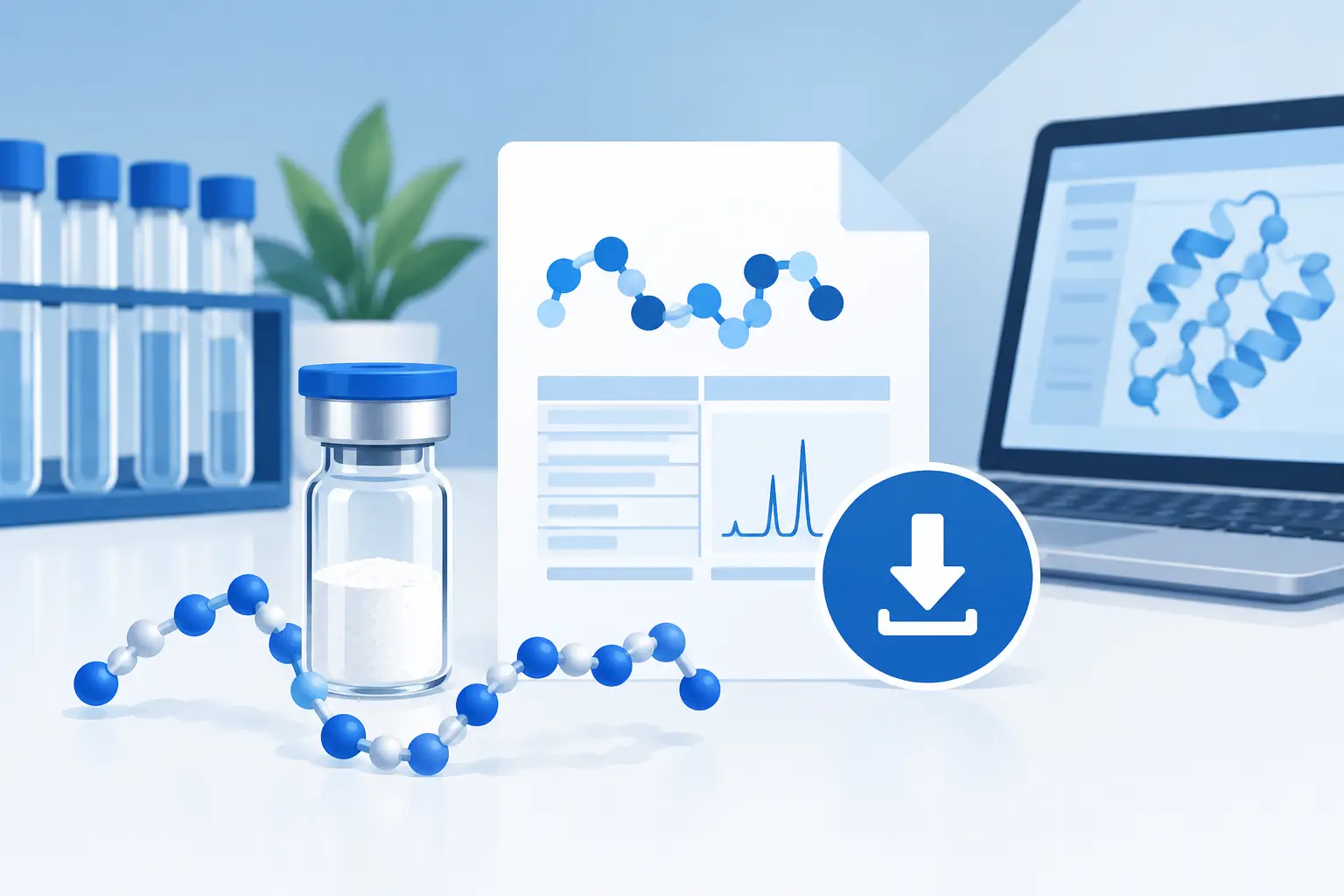
This is particularly relevant for research peptides with closely related sequences, modified residues, or complex handling requirements. A high-quality source should make it straightforward to evaluate the lot through transparent analytical documentation. Synvia Peptides applies a 99%+ purity standard with third-party HPLC and mass spectrometry testing and downloadable batch COAs to support that evaluation for qualified research buyers.
No supplier document removes the laboratory’s responsibility to set fit-for-purpose acceptance criteria. It does, however, provide the evidence needed to make a controlled procurement decision instead of relying on a label claim.
For research-use-only peptides, the practical standard is clear: verify that the material is predominantly one component, verify that the component is the intended peptide, and retain the records that connect those findings to the lot in use. That discipline gives the next experiment a more reliable starting point.